To construct a catalog of individual atmospheric river events, we apply a combination of unsupervised clustering algorithms to a pointwise catalog created using the AR detection tool in Wille et al. 2021. In this notebook, we detail the steps of our clustering procedure, showing how it identifies and tracks ARs from this original catalog.
import matplotlib.pyplot as plt
plt.rcParams['text.usetex'] = False
import xarray as xr
import seaborn as sns
from pathlib import Path
import os
import matplotlib.path as mpath
import matplotlib.colors
import cartopy.crs as ccrs
import cartopy.feature as cfeature
from cartopy.util import add_cyclic_point
import matplotlib.path as mpath
import pandas as pd
from matplotlib.cm import prism
from matplotlib.cm import Set3
import numpy as np
from scipy import stats

from artools.display_utils import display_catalog
from artools.loading_utils import load_wille_catalogs, load_ais
from artools.st_dbscan import ST_DBSCAN
/home/jovyan/antarctic_AR_dataset/notebooks
The procedure we use is a modification of the DBSCAN clustering procedure, involving two stages:
Spatial clustering Identify clusters of AR pixels within each time step using DBSCAN
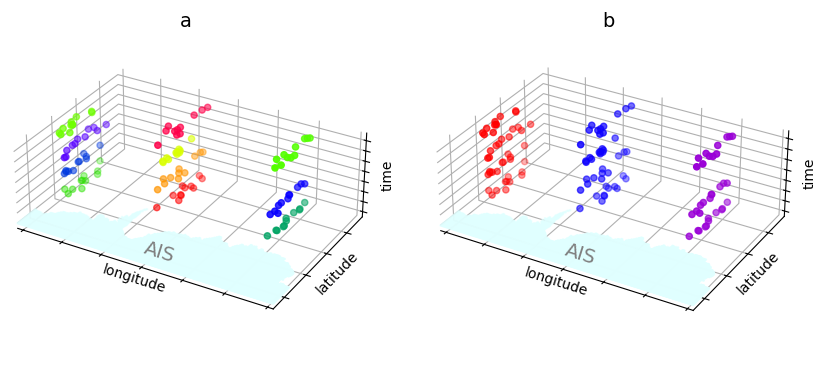
Spatiotemporal clustering Stitch together identified clusters within each time across time using ST-DBSCAN on a representative sample of points from each cluster identified in Step 1
Stage 1: Spatial Clustering
catalogs = load_wille_catalogs(dir_path='../input_data/wille_ar_catalogs/', years=[1980])catalogsLoading...
subcatalog = catalogs.isel(time=slice(120, 140))

# hyperparameters
synoptic_scale = 10**3
km_per_radian = 6.371*(10**3) # arclength (km) on earth subtended by 1 radian

eps_space = synoptic_scale/(2*km_per_radian) # converted to radians for Haversine metric
eps_space_1 = eps_space
eps_space_2 = eps_space
eps_time = 12/24
minpts_1 = 5
minpts_2 = 5
n_rep_pts = 10

# instantiating the clustering object
cluster_obj = ST_DBSCAN(eps_space_1, eps_space_2, eps_time, minpts_1, minpts_2, n_rep_pts)
# doing the spatiotemporal clustering
df = cluster_obj.fit(subcatalog)
Beginning spatial clustering step.
100%|██████████| 20/20 [00:01<00:00, 14.02it/s]
Beginning spatiotemporal clustering step.
time = df.iloc[9].time

# instantiate the animation
fig, ax = plt.subplots(nrows=1, ncols=3, figsize=(10,5), subplot_kw=dict(projection=ccrs.Stereographic(central_longitude=0., central_latitude=-90.)))

unique_clusters = df['cluster'].unique()
color_mapping = {unique_clusters[j]:prism(j/12) for j in range(len(unique_clusters)) }

if (time == df.time).any():
    dat = df[df['time'] == time]
    n_clusts = dat.shape[0]

    for i in range(n_clusts):
        cluster = dat['cluster'].iloc[i]
        ax[0].scatter(dat['lons'].iloc[i], dat['lats'].iloc[i], transform=ccrs.PlateCarree(), s=1, color='gray', zorder=30)
        ax[1].scatter(dat['lons'].iloc[i], dat['lats'].iloc[i], transform=ccrs.PlateCarree(), s=1, color=color_mapping[cluster], label=str(cluster), zorder=30)
        ax[2].scatter(dat['rep_lons'].iloc[i], dat['rep_lats'].iloc[i], transform=ccrs.PlateCarree(), s=1, color=color_mapping[cluster], label=str(cluster), zorder=30)

for i in range(len(ax)):

    ax[i].set_extent([-180,180,-90,-39], ccrs.PlateCarree())
    ice_shelf_poly = cfeature.NaturalEarthFeature('physical', 'antarctic_ice_shelves_polys', '50m',edgecolor='none',facecolor='lightcyan') # 10m, 50m, 110m
    ax[i].add_feature(ice_shelf_poly,linewidth=3)
    ice_shelf_line = cfeature.NaturalEarthFeature('physical', 'antarctic_ice_shelves_lines', '50m',edgecolor='black',facecolor='none') # 10m, 50m, 110m
    ax[i].add_feature(ice_shelf_line,linewidth=1,zorder=13)
    ax[i].coastlines(resolution='110m',linewidth=1,zorder=32)


    # Map extent
    theta = np.linspace(0, 2*np.pi, 100)
    center, radius = [0.5, 0.5], 0.5
    verts = np.vstack([np.sin(theta), np.cos(theta)]).T
    circle = mpath.Path(verts * radius + center)
    ax[i].set_boundary(circle, transform=ax[i].transAxes)
    ax[i].gridlines(alpha=0.5, zorder=33)

    time_ts = pd.Timestamp(time)

ax[0].set_title('a')
ax[1].set_title('b')
ax[2].set_title('c')

plt.savefig('../output/spatial_clustering.png', bbox_inches='tight')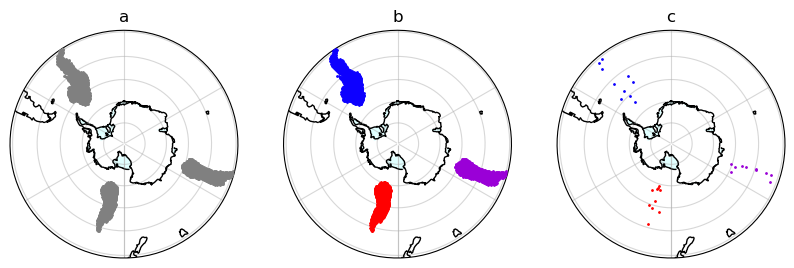
Stage 2: Spatiotemporal Clustering
unpacked_df = cluster_obj.unpack_df(df, 'cluster')
unpacked_df = unpacked_df[unpacked_df.time.dt.day == 8]
unpacked_df = unpacked_df[unpacked_df.time.dt.hour % 6 == 0]
ais_mask = np.radians(np.array(list(load_ais(points=True))))
fig = plt.figure(figsize=(10,5))
ax = fig.add_subplot(1,2,2, projection='3d')
ax.scatter(unpacked_df.lon, unpacked_df.lat, unpacked_df.time.dt.hour, c=prism((unpacked_df.cluster-1)/12))
ax.scatter(ais_mask[:,1], ais_mask[:,0], 0, c='lightcyan', s=0.5, zorder=30)
ax.xaxis.set_pane_color((1.0, 1.0, 1.0, 0.0))
ax.yaxis.set_pane_color((1.0, 1.0, 1.0, 0.0))
ax.zaxis.set_pane_color((1.0, 1.0, 1.0, 0.0))
ax.xaxis.set_ticklabels([])
ax.yaxis.set_ticklabels([])
ax.zaxis.set_ticklabels([])
ax.set_xlabel('longitude', labelpad=-12)
ax.set_ylabel('latitude', labelpad=-12)
ax.set_zlabel('time', rotation=90, labelpad=-12)
ax.axes.set_ylim3d(bottom=min(ais_mask[:,0]))
ax.axes.set_xlim3d(left=min(ais_mask[:,1]))
ax.axes.set_xlim3d(right=max(ais_mask[:,1]))
ax.view_init(azim=-60, elev=30)
ax.set_box_aspect((1.45, 1, 0.5))
ax.text(x=0, y=-1.5, z=0, s='AIS', zorder=31, c='gray', zdir='x', fontsize=14)
ax.set_title('b', fontsize=14, y=1.01)
ax = fig.add_subplot(1,2,1, projection='3d')
ax.scatter(unpacked_df.lon, unpacked_df.lat, unpacked_df.time.dt.hour, c=prism((unpacked_df.space_cluster-1)/20))
ax.scatter(ais_mask[:,1], ais_mask[:,0], 0, c='lightcyan', s=0.5)
ax.xaxis.set_pane_color((1.0, 1.0, 1.0, 0.0))
ax.yaxis.set_pane_color((1.0, 1.0, 1.0, 0.0))
ax.zaxis.set_pane_color((1.0, 1.0, 1.0, 0.0))
ax.xaxis.set_ticklabels([])
ax.yaxis.set_ticklabels([])
ax.zaxis.set_ticklabels([])
ax.set_xlabel('longitude', labelpad=-12)
ax.set_ylabel('latitude', labelpad=-12)
ax.set_zlabel('time', rotation=90, labelpad=-12)
ax.axes.set_ylim3d(bottom=min(ais_mask[:,0]))
ax.axes.set_xlim3d(left=min(ais_mask[:,1]))
ax.axes.set_xlim3d(right=max(ais_mask[:,1]))
ax.view_init(azim=-60, elev=30)
ax.set_title('a', fontsize=14, y=1.01)
ax.set_box_aspect((1.5, 1, 0.5))
ax.text(x=0, y=-1.5, z=0, s='AIS', zorder=31, c='gray', zdir='x', fontsize=14);
plt.savefig('../output/spatiotemporal_stitching.png', bbox_inches='tight')